Guidewire is a memory.
You don't need to build another Guidewire. You need to build the post-Guidewire system.
Project Evergreen is an AI-native platform that replaces your legacy P&C core — policy, claims, billing — using autonomous AI agents, a Gosu transpiler, and a self-service migration portal. No big-bang cutover. No Gosu consultants. No excuses.
Guidewire is holding your business hostage.
Guidewire dominates P&C insurance with 570+ global carriers. But that dominance is built on a model that is fundamentally incompatible with the AI era. Here is exactly how it is costing you.
Gosu Lock-In: 2 Million Lines of Hostage Code
Guidewire's proprietary Gosu language is their primary weapon against you. The average carrier runs 2 million lines of Gosu. Every line is a chain. Replacing Guidewire without a transpiler costs $10M+ in manual re-coding — and years of your team's time.
6–9 Month Release Cycles in a Real-Time World
Guidewire ships major features once or twice a year. Your competitors are shipping AI-powered products weekly. By the time Guidewire's next release arrives, the market has moved on. You are perpetually behind.
10-Year Contracts That Punish Success
Guidewire's pricing is based on premiums written or user counts — meaning the more successful your business becomes, the more you pay. Long-term contracts with no flexibility trap you in a model that misaligns vendor incentives with your growth.
A Closed Ecosystem That Bottlenecks Your Data
Guidewire controls your data access through their PartnerConnect marketplace. AI models are only as good as their data. When your vendor controls the data tap, your AI strategy is permanently capped. You cannot build intelligence on top of a data bottleneck.
"Guidewire's greatest strength — being a deeply integrated, end-to-end suite — is its greatest weakness in an AI world. You don't need to replace them all at once. You need to build an intelligent, data-centric layer around them, use AI to automate the migration, and then let them wither as a commodity utility."
We are building the AI Swarm that eats Guidewire's lunch.
Not a "better Guidewire." A post-Guidewire system. Four capabilities that make the entire category obsolete.
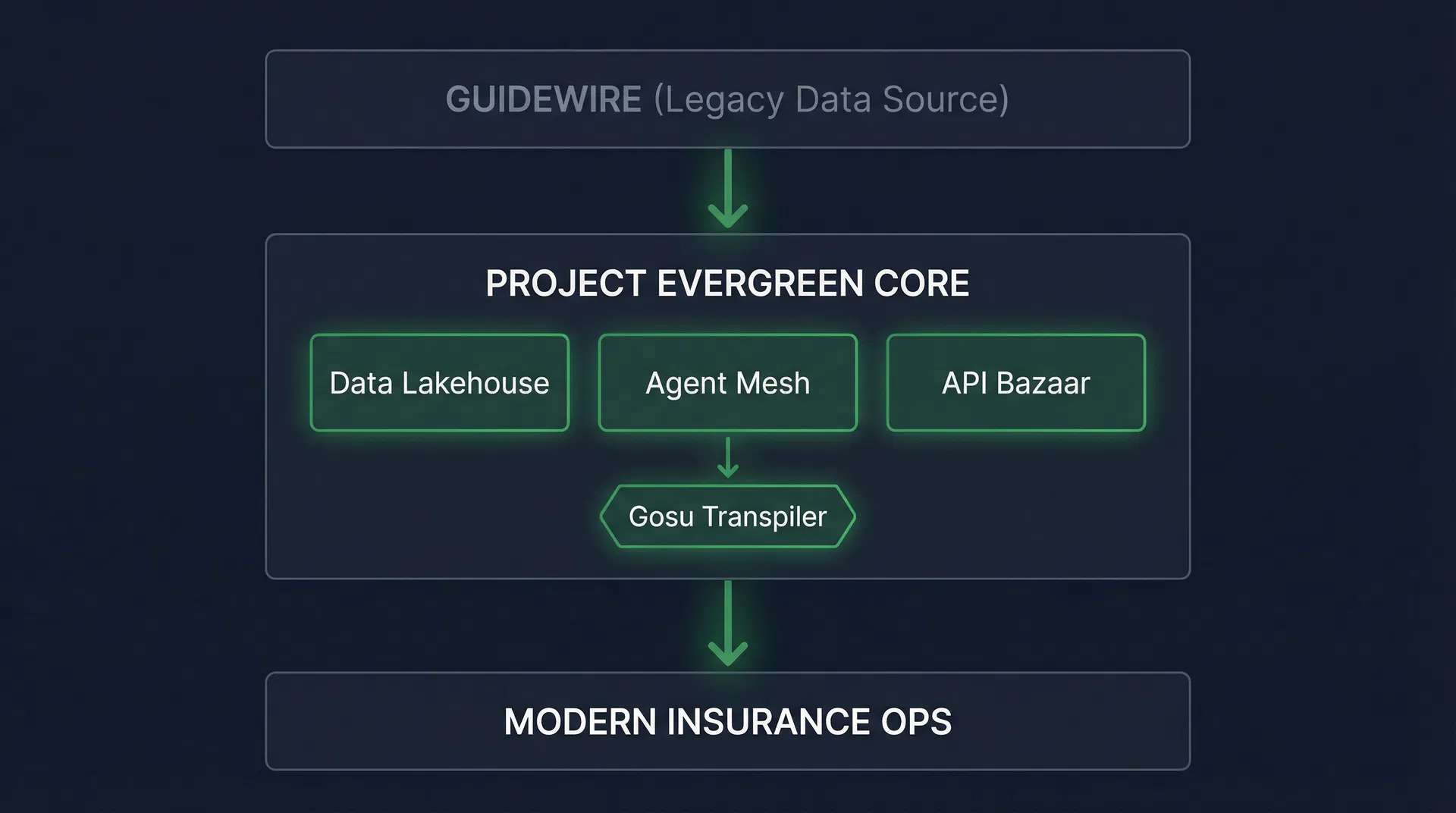
The Gosu Transpiler — Your Secret Weapon
Gosu is just a JVM language. We parse its Abstract Syntax Tree using ANTLR4 and generate idiomatic Go. 70% of your Gosu logic converts automatically. The remaining 30% is flagged for review. Migration cost drops 80% overnight. This is the product that breaks Guidewire's lock-in.
The AI Agent Mesh — No Screens, Just Decisions
Our Underwriting Agent evaluates risks, calculates premiums, and auto-binds policies using vector search and LLMs. Our Claims Agent pays simple claims instantly. No 15-screen workflows. No IT tickets. Autonomous decisions with full audit trails for NAIC compliance.
The Data Lakehouse — Fluid, Not Frozen
Apache Iceberg gives you schema evolution without downtime. Every policy gets a 1536-dimensional vector embedding, enabling semantic search for similar risks in milliseconds — something Guidewire cannot do. Your data becomes a competitive asset, not a liability.
NAIC Compliance by Design — Not Retrofit
24 states have adopted the NAIC Model Bulletin on AI Systems. Every agent logs its reasoning. Every adverse action triggers a human review queue. The Gosu Transpiler flags potential redlining logic. You are not just replacing Guidewire — you are replacing the era of ungovernable AI.
The Kill Chain Architecture
We use the EATML pattern — Extract, Analyze, Transform, Migrate, Learn — to systematically drain Guidewire of its value while building intelligence in our layer.
Guidewire becomes a dumb transaction processor. The intelligence lives in Evergreen. Then we cut the cord.
Four sprints.
One decommission.
We do not do big-bang cutovers. We use the strangler pattern — building intelligence around Guidewire, proving superiority in parallel, then cutting the cord when the match rate hits 99.9%.
Foundation & The Gosu Killer
- Gosu-to-Go Transpiler (POC) — converts 70% of logic automatically
- Data Lakehouse Schema with Apache Iceberg and vector embeddings
- EATML pipeline ingesting Guidewire data into the new layer
The AI Agent Mesh
- Underwriting Agent — auto-binds policies using LLM + vector search
- Claims Adjuster Agent — instant payment for sub-$5K claims
- NAIC Governance Layer — every decision logged with reasoning
The Parallel Run Orchestrator
- Dual-processing engine routing transactions to both systems
- Structural diff engine comparing Guidewire vs. Evergreen outputs
- Real-time match rate tracking toward 99.9% threshold
The Migration Portal
- Self-service dashboard: Gosu files, policies migrated, match rate
- WebSocket-streamed audit log for real-time transparency
- Final Cutover button — unlocks at 99.9% match over 30 days
Guidewire vs. Evergreen
The numbers do not lie.